Whittington House.
Old Whittington. Chesterfield.
Not to be confused with Whittington Grange or
Whittington Hall.
Memories
On Friday the 12th of September 1947 we arrived at Whittington House. Jack and Doris Baldwin both being 37 and two sons, Brian aged 11 and myself, Graham Clarke Baldwin aged 7. We had moved from Irlams O’th Height, Salford 6 in Lancashire after a promise by Father to bring Mother back to Old Whittington the place of her birth and the area where her Family lived. Earlier in the year we’d been visiting our Grandparents in New Whittington when Father saw an advertisement in the Derbyshire Times for a position at Whittington House. He applied for, and was given, the position of Chauffeur handyman at the Wage of £3-0-0 per week plus the tied cottage, and so here we were. The retiring Chauffeur was Mr Fred Carpenter, he was a widower and lived here along with his Daughter, Freda, who was a local schoolteacher. They moved down the road to another, smaller, cottage which was also part of the estate.
Whittington House was the family home Of the Swanwick family, handed down from Frederick Swanwick, a Railway Pioneer working with and for George Stephenson, down to Ald Eric Drayton Swanwick, a lawyer, JP and Landowner. He, his wife Margery Eleanor, and son Mr Michael ( the district Coroner) lived here permantly. Another Son Mr Graham S ( later to become Sir Graham Swanwick QC the leading council in the A6. Murder trial that convicted and hanged James Hanratty, he was later to become a high court Judge.) moved to London and sadly their youngest son Captain Roy Norton Swanwick had been killed in action in Germany in 1945.
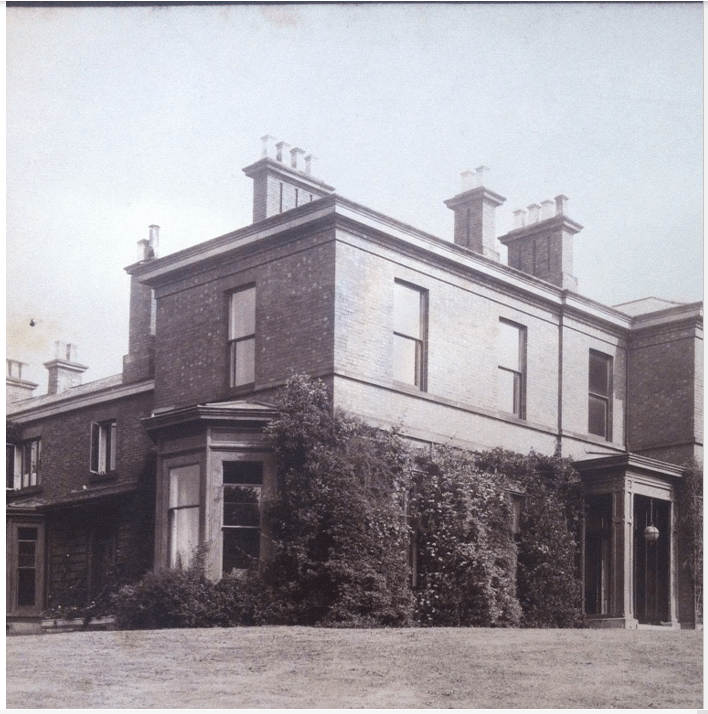
The Big House, as we called it, could be approached by either of two driveways or a pathway which meandered through the gardens and connected the stables with the House . The front drive, covered in Tar Macadam, left the main road through a wide White gate and, on a slight incline, passed through shrubberies which opened out onto upward sloping lawns and then swept left and back onto a turning area in front of the Georgian Style Red Brick frontage. This area had a covering of Red Granite chippings and was designed, and large enough, to turn a horse drawn carriage round. Two Stone pillars supported a flat roofed entrance porch which gave the house a very grand appearance. To the right of the Front Door and Dining room window was the Annex, a long narrow room which contained all sorts of things, I never really knew what was in there apart from archery targets and deck chairs. The other, Back, drive was accessed again from the main road but through a gated yard where the original stables and carriage house stood along with the Chauffeur’s cottage. The word cottage is misleading as the Red Brick house was quite big. Originally there were only two rooms downstairs, a large living/sitting/dining room and a kitchen near to which was a pantry. Upstairs were four very big rooms one of which had had a bath, airing cupboard and toilet fitted. Fire grates were in each of these rooms but rarely used unless illness prevailed. A third room downstairs was added later, converted from an open fronted garage and made a useful sitting room.
This drive was covered in limestone chippings but was well worn and had grass growing in the centre between the wheel tracks. The gradual incline twisted for about one hundred yards through trees passing the Squash Court and Asparagus beds on the left until terminating at the rear entrance to the house. Small vans could turn around here and drivers would take their goods in to the building through an outer entrance off which was a purpose made Dog Yard with kennels. A large door on the right gave access to the Scullery. This room had been the original Kitchen and housed a large old Cooking range and two large sinks. Off this Scullery a new Kitchen and staff sitting room with bedrooms above had been added at some time, probably in the early 1920’s. From the Scullery a large wide Green Baize Covered swinging door lead through to the main part of the house and at this point there was a Butler’s Pantry and a door which gave access to a flight of stone steps leading down to the cellars. At some point a tunnel had been constructed from the cellars running in an Eastward direction to a point in the middle of a large lawn, but after about 20 yards it came to an abrupt end, what purpose could it have been used for?
The Green door separated the working part of the house from the family living part and I rarely went beyond it. It lead into a very large area off which were other rooms and the grand staircase. There was the day nursery, Mr Swanwick’s study, the Withdrawing room ( I say withdrawing room as this was where, after Dinner, the Ladies would have withdrawn whilst the Gentlemen would take their Brandy and Cigars in to the Billiards room). It had a grand piano as well as a large Harp. The views down the gardens were superb, the Dining room was quite grand having a long centre table. There was access to the Gun Room and also another door which opened in to the Dog Yard and Kennels. The Front Door was at the end of a smaller vestibule.
One particular and eerie object had pride of place next to the Dinner gong on a low table in this area, it was a real and genuine “Shrunken Head” from a South American native tribe of head hunters. About the size of a large Orange it was gruesome, complete with all features and long Black hair it stood for years on a custom made round wooden plinth with a glass dome as a cover before being taken to and stored in the store room over the garage. It probably came as a result of Madam having been born in Rio De Janeiro but British through parentage.
Opposite to the rear entrance and up some stone steps was the huge kitchen garden complete with heated greenhouses. A very high stone wall ran the length of the “Slack walk” and the other three sides were of Hawthorne and various other bushes. The Slack Walk was /is a local pathway which links the Village with the Parish church and beyond, so called Slack because of its rising elevation. In a large corner of this area was the “Wood Yard” where all the logs and kindling for the House fires was kept and brought in as required. All timber from fallen branches and trees ended up here ready for use.
This Drive was used for all the deliveries and by tradesmen, the only exception being that twice a year Coke was delivered and tipped near to the front door where a chute was in situ to take the coke down to the boiler room. In here stood a massive boiler which supplied heat and hot water to the whole of the house. It required daily cleaning and filling with coke, this was done every morning and again in the early evening by my Father. After seeing to the Boiler in the early morning his next task was to clean and polish the piles of dirty shoes and boots left out by the Family.
Entering the Garage yard from the road at the bottom of the Back drive the stables, standing on the right, comprised of four “loose” boxes or stalls with a loft above for fodder which could be fed down through chutes to the individual feeding troughs. A door from the stable led through to what was now used as a garage. A midden for the horse Manure was at the end of this building but in later years it was redesigned and made into a rockery. At one time there was an underground tank surmounted by a pump to take liquid from the tank for use on the gardens. After the decline of horses the stables were used as another Wood store.
On the other side of the yard was the large Carriage House which would take two big carriages with ease, the massive doors moved easily on iron rails and could overlap each other, in the earlier days tack was kept and maintained in an adjoining harness room. From this room a staircase led up to an extensive store room where surplus furniture and pictures from the big house were kept until needed.
In 1947 the garage was home to a 1939 Black Humber Super Snipe, Registration Number GRA930, and an earlier Grey and Sable coloured 14 HP Vauxhall, MG 4207, which was the Coroners car. Across the yard next to the stable in the small garage stood Miss Kitty’s Morris Eight 2 door 4 seater car with a fold down hood, this car was only used when Miss Kitty and sons visited but always kept in readiness. Miss Kitty’s married name was originally Yeatman-Biggs, her first husband, Major Arthur Huyshe Yeatman-Biggs was one of Wingate’s Chindits and tragically killed in action in Burma in around 1944. She married again to Lieutenant Colonel Guy Stansfeld DSO of the Green Howards. He always brought with him his two terriers, Buttons and Bunny and his Lurcher dog called Amber. The Ginger house cat was called Wendy and the house Dog was a lovely friendly White Clumber Spaniel called Jumbles.
Having moved from the outskirts of Salford City to a village setting was, at the outset, a vast change for us two boys. There was no electric milk float delivering daily milk as we had only to walk across the road to the farm to collect Milk and Eggs. George and Mary Finney kept “Bower Farm” and they had three Daughters, Muriel and then twins Margaret and Mary. As we were part of the “Estate” we had access to the gardens and land pertaining to the House and this was so different to Urban living. On the road and joined on to the Harness room was the “Red House”, this was another fine Red Brick Georgian looking house and belonged to Mr and Mrs Young, he was the Manager of the Midland Bank in Chesterfield, on their demise it was bought by Mr and Mrs Jack Farnsworth, a Civil Engineer, from New Whittington.
Of an evening Father would go up to the big house to tend the boiler for the night and there he’d be given the plan for the morrow. It could be what time a car would be needed or if not just general maintenance, after a short time it was evident that he was quite capable of finding plenty to do without prompting, either helping Bill Crick, the gardener, in the large gardens, usually doing the mowing and hedge and tree clipping, that was after he’d sorted out the ancient Atco petrol engined 36”cut Grass cutter which was always in need of some attention. This forlorn machine was housed along with Tennis netting and the odd deck chair, in a thatched circular, but rarely used Summer House. In the summer months the Tennis court needed regular cutting and marking out. Mowing the grounds could take two weeks depending on the weather and other commitments. In the autumn when leaves were falling from the trees it could take days, if not weeks, to clear them up. Besom Brooms would be used and they were then taken by heavy wooden three tier wheelbarrow to one particular area where they’d be left to rot down and then used as compost in the vegetable garden.
Some family holidays were taken at the “Falls of Lora” Hotel in Connell Ferry near to Oban in Scotland. Father staying with a family near to the Hotel and always on call for day trips out. The grandsons loved it when he was able to spend time with them fishing on the loch! During these holidays, when the family was away, Brayshaws the decorators would come and do what was necessary either inside or outside.
The Faithful Humber made the trips with-out any problems and members of the family followed on by train.
Full time “live in” staff in the house consisted of Miss Roberts, a quite foreboding type who ran the house, later Miss Janine Dolman took over the role.
The “Cook” was Mrs Ruby Robinson, a widow from the Stockton on Tees area who arrived three months before we did. She produced all of the meals for the family and rarely had any time off. At different times throughout the year there could be Evening Dinner Parties or Cocktail Parties for friends of the family and included local dignitaries and business owners such as the Sitwells and Kennings. My Mother, who had worked in service as a girl would be drafted in to serve at table whilst Father would be in the grounds arranging the car parking for the guests.
Two young ladies, Elsie, a large buxom girl, lived in and was employed as a general maid, another general maid was Martha who came in on a daily basis, she, for whatever reason, was a resident of Whittington Hall. At that time Whittington Hall was regarded by many as a Home for wayward Girls, some with learning difficulties and others with a variety of problems. Other part time help came in as requested. Mrs Annie Brearly, a widow who lived in the village, was always on hand and was a regular, although part time, daily help. A seamstress lived in the village and attended to all of the sewing and such. General building work was carried out by Bill Cooper who also kept the Bull’s Head Public house in the village. Mr Green the cobbler had a small shop nearby on the High St. Local people would be employed where possible.
From the age of 11 I took over a task which my brother had until he started work, this was to run up the Back drive to the Big House at 5pm Monday – Friday and collect the outgoing post. Mr Swanwick worked in his study during the day and there were many letters, already stamped, to take to the village Post Box. Either Elsie or Martha would go to Mr Swanwick’s study and bring the mail to me. At the end of each month there would be some letters to be taken by hand to the people in the village who had done work, I assume that they contained their payment.
It was fine in summer but in the winter when it was dark and raining it was frightening for me to run up through the trees thinking that every assassin in the area was waiting behind every shrub to get me. I did this for four years until I started work and was suitably rewarded at Christmas time.
Every year there would be a Garden Party when the grounds were opened and some organisations like the WVS, local Boy Scout and Wolf Cub troops , Women’s institute and the like would have stalls selling home made jams and cakes and soft drinks. It never rained or so I seem to remember.
Sunday mornings were usually quiet for us but the Humber and Vauxhall would be out in the stable yard ticking over ready for the family to walk down the central path for them to drive to Chesterfield and the Elder Yard Chapel where they worshipped. Although their forbears were buried in the Spital Burial ground the remains of Eric and Margery Swanwick were buried near to the main door of St Bartholomew’s church in Old Whittington.
On the passing of Mr Eric Swanwick in 1955 it was decided that the House was too big for the remaining family and so Madam and Mr Michael moved into the Dower House. Situated at the bottom of the front drive, it had been rented to a Major Coker and his family, they were moved up the road to a pair of cottages which were made into one lovely dwelling for them. This had previously been rented to the District Nurse who was moved to a council flat on Gypsy Lane, she was not happy with her lot! She was a very popular lady who rode her bicycle around to visit patients with her Gladstone bag on the rear carrier.
The contents of the Big house were sold during a two day sale, large pieces were auctioned inside the house and all the rest of the unwanted items were laid out on many trestle tables on the lawn and included boxes of Cutlery, Pottery, small pictures, Linen and everything else that wasn’t needed for the future in the Dower House.
Whittington House was then bought by Mr George Price, an industrial Photographer, who opened it up as a residential Old People’s Home. This survived for a number of years until being sold again along with some land and developed into a “ life style retirement complex” and so it remains with the Big house gone!
In the meantime Madam had passed on and then Mr Michael was coerced into building a bungalow near to the original Kitchen Garden, sadly this situation didn’t last long and he then moved out, leaving it in the hands of the people who had instigated the Build? He then bought an apartment in the Brampton area from which he didn’t move. The Dower House was soon demolished to make way for some “Executive” Houses” !!!!!!
This was probably the last big house in the area which continued life as it was before the war and I’m so pleased and proud to have had the privilege of being part of it.
The end of a wonderful era!
Graham Clarke Baldwin
Now living in S/W France
February 2023

 Old Whittington One Place Study