VE DAY + 75 YEARS

Although I have not researched the men who died during World War Two and who are listed on Old Whittington War Memorial on Church Street, I thought it would be timely to remember the 25 on this page today. Sadly I am unable to add the dates or where the men died at the moment.

BENNETT                    S

BURGIN                      E

BUXTON                     S

COOKE                        R G

ELLIOTT                     J

GENT                          W H

GIBBINS                      H S

GOODWIN                  H

GOWER                       E

HAYES                        A

HILL                            S

HUGHES                     G

JENNINGS                   J G

JOHNSON                    R

LAMBERT                   R

MARSDEN                  G

MITCHLEY                 G E

PARKIN                       W

POWELL                     R

RAYBOULD                W

SIDDALL                     J

SWANWICK                R W

WAINWRIGHT            W

WHITBREAD              W H

WILSON                      K

If anybody has any photos of any of the men or any family stories about them they would like to share then please do so below in the comments box.

I found this poem trawling through the internet and although it was written in commemoration of the 1st Iraq War I thought the sentiment was quite fitting for any war.

unmentionedVE-Day-poem-724x1024


396495


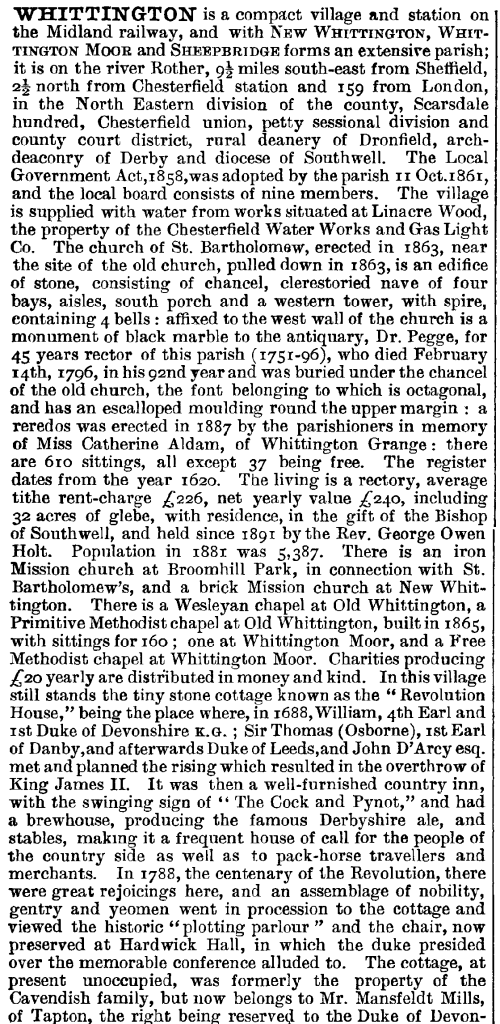
Bulmers Directory 1895

Just updated some more information from Bulmers Directory for 1895.  It is full of information on Old, New and Whittington Moor.

Whittington was growing rapidly in 1895 thanks to the new industries.  Houses had been built at New Whittington and Sheepbridge/Brushes area to accommodate the workers who came from all over England to work at Sheepbridge and in the coal fields.   Shops and businesses had sprung up to provide services for the ever increasing population.

Many names that are still familiar in the area are listed in the directory.

If you are interested in finding out more, or if you had ancestors in Whittington in 1895 you can look at the transcribed Old Whittington entries here

Or the full entry for Whittington here


Whittington in 1848

Whittington in 1848 had still not been divided into New, Old and Moor when this excerpt was written for the  Topographical Dictionary of England  (originally published by S Lewis London 1848).

Whittington (St. Bartholomew)

WHITTINGTON (St. Bartholomew,) a parish, in the union of Chesterfield, hundred of Scarsdale, N. division of the county of Derby, 2¼ miles (N.) from Chesterfield; containing 751 inhabitants. A former public-house here is distinguished by the name of the Revolution House, from the adjournment to it of a select meeting of friends to liberty and the Protestant religion, held on Whittington moor early in 1688, at which the Earl (afterwards Duke) of Devonshire, the Earl of Derby (afterwards Duke of Leeds), Lord Delamere, and Mr. John D’Arcy, eldest son of the Earl of Holderness, attended. When the centenary anniversary of that event was commemorated in Derbyshire, in 1788, the committee dined on the preceding day at this house; and on the anniversary, a sermon was preached in the parochial church by Dr. Pegge, the celebrated antiquary, then rector, before the descendants of those illustrious persons, and a large assemblage of the most distinguished families of the county, who afterwards went in procession to take refreshment at the Revolution House, and then proceeded to Chesterfield to dinner. The house, with the venerable chair which has stood in the “Plotting Parlour” since 1688, and which was occupied by the Earl of Devonshire during the memorable conference, was recently sold for £725. The building is in a most dilapidated state, and has long ceased to be available for an inn; its sign is now borne by a substantial newly-built house adjoining. The parish comprises 1573a. 2r. 25p., a considerable portion being uninclosed moor, on which the Chesterfield races are held; potters’ clay of good quality is found, and the manufacture of earthenware is carried on to a considerable extent. The Chesterfield canal and the Midland railway pass through the parish. The living is a rectory, valued in the king’s books at £7. 10. 10.; net income, £302; patron, the Bishop of Lichfield. The tithes were partly exchanged for corn-rents, under an act of inclosure, in 1821, and the remainder have been lately commuted for a rentcharge of £183. 6.; the glebe comprises 33 acres. The church is an ancient structure; the chancel was rebuilt in 1827. There is a place of worship for Wesleyans. A free school was founded in 1674, by Peter Webster, who in 1678 gave £200 to purchase land for it; and Joshua Webster, in 1681, gave some land for teaching ten children: the total income is £73. A chalybeate spring here was formerly much resorted to.

The information was taken from the following website, which holds facts and information for many English towns and villages.

https://www.british-history.ac.uk/topographical-dict/england/


Whittington Church

Been to the Local Studies library today and found this engraving of Whittington Church in Fords History of Chesterfield. It is not dated and doesn’t mention any information about it but the book was published in 1839 so that gives a rough idea of the date.

whittington church etching

Even though it is showing a funeral I think its a very detailed picture of Whittington church and churchyard.

NEWSPAPER CUTTINGS

I thought I would start a new chapter on the Old Whittington one Place study website https://oldwhittingtonops.com/newspaper-reports/

As I was researching the men on the war memorial I was coming across all sorts different newspaper reports concerning Old Whittington. I thought I would try and share a few on here and also on the webpage.

Todays offering is a celebration of the Centenary of the ‘Glorious revolution’ from the Derbyshire Mercury 2nd October 1788. From the sounds of it quite a big celebration – the cost 1 guinea! Checking the currency convertor website one guinea in 1790 would be the equivalent of £80 now, so the celebrations would only be open to the wealthy of the area!

P1020458